

Why we wrote this
Roughly half of all Steam games earn under $1,000 in lifetime revenue.
For studios, this means you need to survive long enough to launch multiple titles. This longevity is built well before a single player sees the game.
After working with 800+ games, we've seen two failure modes cut studios short:
- Over-investing in headcount and infrastructure before validating player demand.
- Under-investing in IP ownership and legal foundations. By the time those gaps surface, fixing them costs more than the original mistake.
So, to help you avoid this, we collated our learnings into a free guide. It covers:
- How to choose the right operational structure before registering anything
- Why founder and contractor IP ownership needs to be settled early
- How to plan three runways before raising or hiring
- How to get on Steam from day one and use it as a demand-testing tool
- How to read wishlist and engagement data to make funding decisions
- How to stay fundable without overbuilding before a publisher conversation
I hope it saves you some time and money before you commit to anything significant.
Robbie Ferguson, Co-Founder and President at Immutable

P.S. We built Immutable to help studios build and own their pre-launch player audience from day one. The Ubisoft / Might & Magic: Fates cohort converted at 2.8x higher on Day 1 than the standard storefront flow. Book a free demo to see what that could mean for your launch.
Note
This content is meant to inform and educate. It is not a substitute for advice tailored to your specific circumstances. Always evaluate options in the context of your own goals, constraints, and (where relevant) professional guidance. While care has been taken in the preparation of this guide, no guarantees are made as to its accuracy, completeness, currency or that it will be error-free.
How to start a game studio: the steps
- Decide whether you are founding a studio or shipping one game project.
- Make the four founding decisions in order: shape, first-project model, commercial system and risk budget.
- Run a co-founder compatibility check before splitting equity.
- Pick your first-project model and register the business entity.
- Put founder agreements and IP ownership in writing.
- Define how the team works before the first hire.
- Model runway on realistic revenue, not hoped-for revenue.
- Put the boring operations in place, starting with version control for code, art and design files.
- Build a production system so work, files and decisions stay findable.
- Launch a Steam Coming Soon page early and start collecting wishlists.
- Build a marketing funnel that captures players you can reach again.
- Track which channels actually produce wishlists.
- Pick a funding path: bootstrapping, contract work, crowdfunding, grants, a publisher deal or investment.
- Stay publisher-ready with demand evidence and clean paperwork.
Each step links to its section below. The order matters: demand evidence (steps 10 to 12) should start well before funding (step 13), because it is what makes a funding conversation possible.
Part 1: What starting a studio actually is
Most founding advice conflates a studio with a game project. That confusion produces decisions in the wrong order.
1. Studio or game project: the distinction
A studio is the operating entity a founder uses to make and sell multiple games over time. A game project is a production effort with a single deliverable.
Every downstream decision depends on which one you are building.
What each type needs
A studio needs:
- An entity that can hold IP across multiple titles
- A team structure that survives project transitions
- A funding model designed for recurring burn
A game project needs:
- Clean IP ownership documented before development starts
- A budget and runway plan with three scenarios modelled
- Signed contractor agreements before any work is handed off
- An early Steam Coming Soon page
- Records tidy enough to hand off or build on
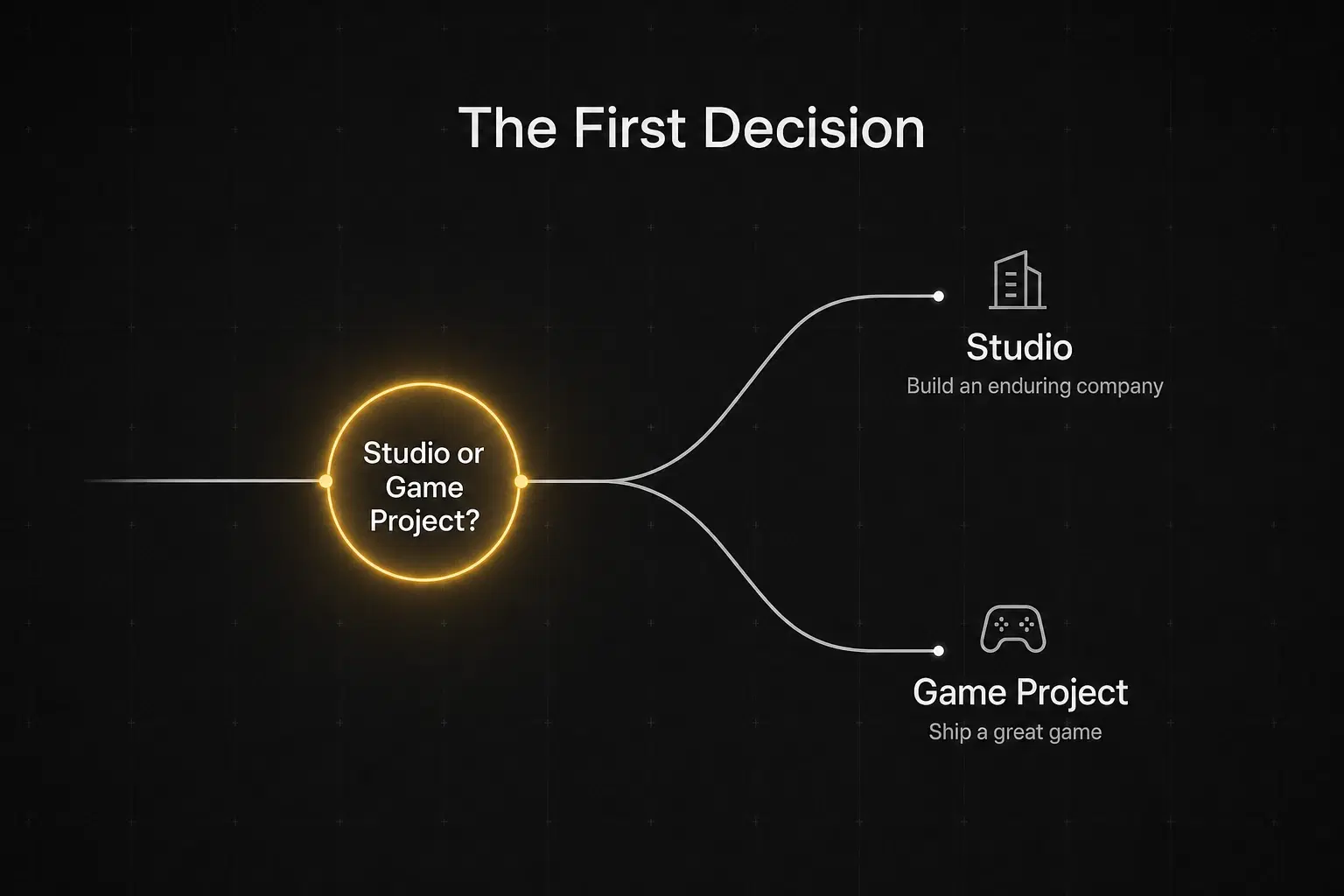
The key question
If the goal is to finish one game rather than build a multi-title entity, a full studio structure is often premature overhead.
Building corporate infrastructure before a shipped product adds cost to a production problem.
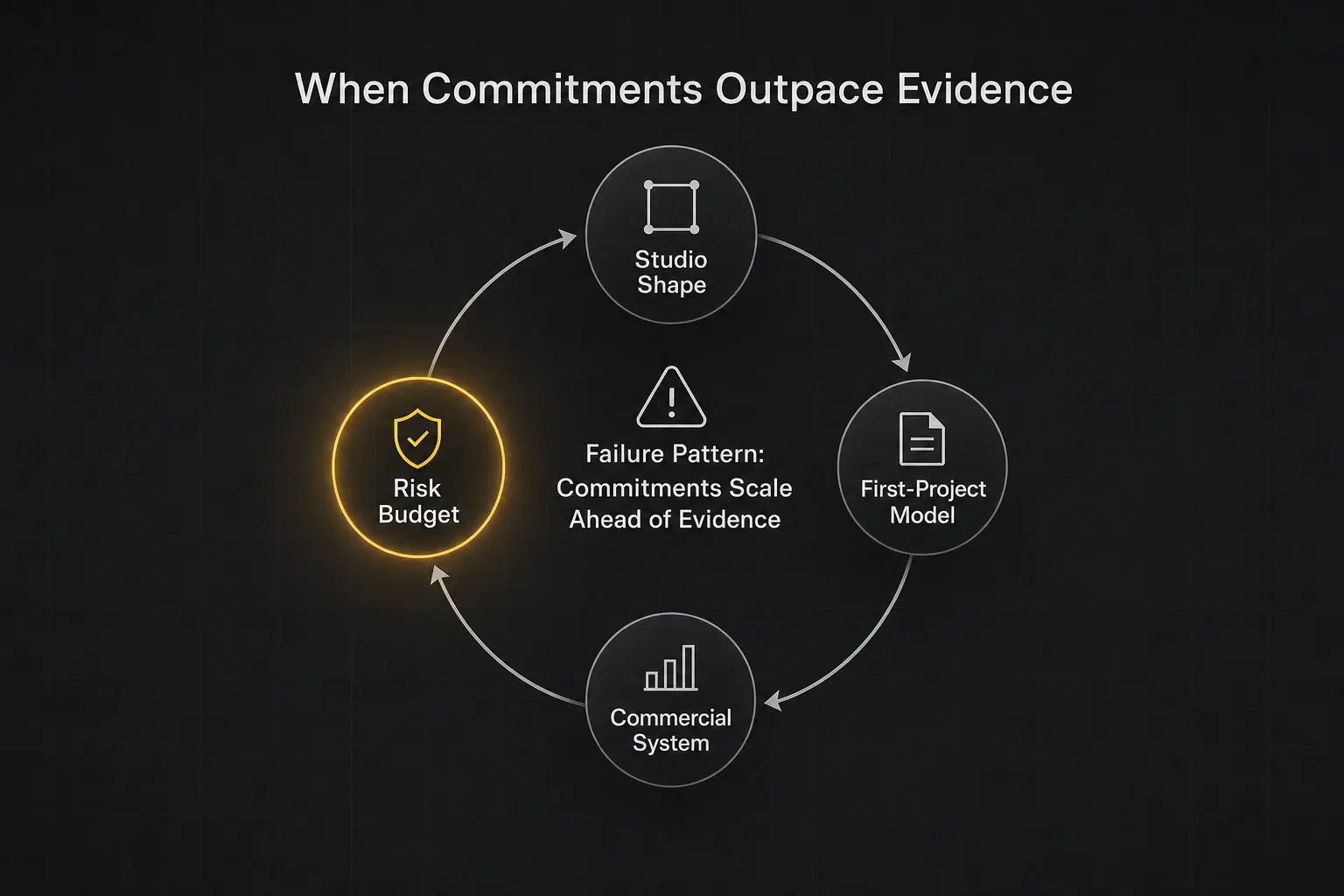
2. The four decisions every studio makes
Every studio makes four foundational decisions. Getting the sequence right matters as much as the decisions themselves.
The four decisions
- Studio shape: who is on the team and in what capacity (founders, employees, contractors)
- First-project model: which type of project validates the studio's core assumption
- Commercial system: how the studio builds and tracks player demand before launch
- Risk budget: how much runway to spend before deciding whether to continue
The failure pattern
Any commitment that grows ahead of evidence becomes a liability.
A studio that hires before it has a shipping signal locks in costs against an unvalidated assumption.
A studio that signs a publisher deal before knowing its conversion numbers has done the same.
The structuring question
One question structures all four decisions: which risk can kill the studio next, and what is the cheapest way to test it?
A studio that asks this before each decision milestone spends less discovering its mistakes.
Key takeaways
- A studio and a game project are different things; choosing the wrong structure adds overhead to a production problem.
- The four decisions (shape, first-project model, commercial system, risk budget) should be made in sequence, not simultaneously.
- Scale commitments only after validating the assumption they depend on; hiring before a shipping signal locks in cost against guesswork.
- One question structures every decision: which risk can kill the studio next, and what is the cheapest way to test it?
Part 2: Getting the foundation right
The foundation is four documents and systems that prevent the most expensive late-stage failures.
Most of those failures surface only when a publisher or co-founder dispute makes them impossible to ignore.
3. Choosing co-founders
Founder disagreements that surface after money is on the table cost far more than ones caught at formation.
Run a compatibility check before splitting equity or signing anything.
The check has three questions.
Have you shipped something together? Even a small side project reveals how you handle creative disagreement under pressure. Founding partnerships that start with big plans and no shared production history have a high attrition rate.
Do your risk tolerances match? One founder going full-time while another keeps their day job creates compounding tension. Be explicit about timelines before you start.
How do you both handle being wrong? A founding team that cannot disagree productively cannot survive the revision cycles every game requires.
These conversations belong before any formal decisions. The paperwork governs what happens when things go wrong.
Warning: equity without vesting
If a co-founder leaves early, an unaddressed equity split can leave the remaining founder building a company they don't fully own. Studios commonly protect against this with a vesting schedule. Discuss equity and vesting terms with a lawyer before anyone signs anything.
4. Choose your first-project model before any paperwork
The paperwork should follow the model, not precede it.
Each model carries a different primary risk. A structure built before the model is chosen solves the wrong problems.
Five models
| Model | Primary risk | What reduces it |
|---|---|---|
| Solo commercial game (1 person, self-funded) | Scope and runway | Keep the game small enough to ship; many solo devs register an entity and confirm IP ownership early, even at this scale |
| Tiny core team (2-4 people, no external funding) | Founder alignment | Founders commonly put a written agreement in place covering equity, ownership, and what happens if someone leaves, and discuss the details with a lawyer before development starts |
| Contractor-heavy project (small core, significant outsourcing) | IP fragmentation | Many studios reduce this risk with a written contractor agreement addressing ownership before work begins, and get local legal advice on the right structure |
| Funded team (external investment, 5-15 people) | Burn without validation | Milestone-released runway protects everyone; a lump-sum disbursement removes the pressure that forces premature decisions |
| Service-funded studio (contract work funding original IP) | Time fragmentation | Service work competes directly for hours that would otherwise go to the original game |
Pro tip
Default to the model with the fewest people until you have validated the game's commercial signal. A practical threshold: 500+ wishlists, or demo data showing players complete the first 10 minutes.
What "set up your entity" means
Entity setup covers four components:
- Registering a legal business entity (LLC, Ltd, Pty Ltd, GmbH; each structure carries different liability and tax implications)
- Opening a separate business bank account (required before Steam payment setup)
- Obtaining the relevant tax identification numbers
- Completing platform payment and tax forms
Steam does not mandate a specific entity type, but requires valid business and banking details.
Pro tip
Get local legal and accounting advice before choosing an entity structure. A games or entertainment lawyer will know the most common setup for indie studios in your jurisdiction.
5. Set up your agreements and IP ownership
Ownership disputes are expensive because they are retroactive. Studios that avoid them typically get founder agreements and contractor IP assignments in place before anyone starts building, while there's nothing yet to fight over.
Publishers and investors will ask who owns the IP. "We think we do, but we never formalized it" is a due-diligence problem that stalls deals.
Warning: Get legal advice before signing anything
Founder equity, vesting, and contractor IP assignment rules vary by jurisdiction and by what each person contributes. This isn't a checklist to build yourself: talk to a games or entertainment lawyer to draft or review your founder agreement and contractor templates before work starts.
6. Define your culture
If founders don't define working norms before production, production pressure defines them; the first scope dispute, demo deadline, or feedback session surfaces what was left unsaid, and fixing a badly set norm mid-production costs more than writing it down at the start.
Working agreements are explicit decisions about how the team operates: who decides what, how disagreement is handled, what the quality bar is, and what the studio will and will not ask of people when things get hard.
For a small studio, I recommend writing down six things before development starts.
The six working agreements
- Decision-making: who has final say on creative, commercial, technical, hiring, and spending decisions
- Conflict process: how disagreements are surfaced and resolved before they become personal
- Feedback norms: how the team reviews work without making it feel like an attack on the person who made it
- Sustainable pace: what the studio will and will not ask of people when deadlines get tight
- Quality bar: what "good enough" means for the first project, and where polish matters most
- Communication rhythm: which meetings, async updates, build reviews, and retrospectives keep everyone aligned
For a two-person team, the whole document might be a single page; none of these need to be essays.
Warning: norms set by default
Undefined working agreements get written by pressure events: the first crunch, the first real creative conflict, or the first spending disagreement. The default is set by whoever is loudest or most anxious, not by what the team would have chosen under less pressure.
Why this belongs at the foundation stage
The same principle that makes IP ownership worth locking down early applies here: working norms should be in place before the first real production conflict arrives.
Undefined norms compound into commercial problems. Slow decisions compress release windows; teams that avoid feedback miss market signals; teams that normalise crunch lose judgment before the build is done.
Key insight: Culture is a commercial variable
Cultural breakdown surfaces in the build long before any post-mortem names it. Decisions slow, scope drifts, and launch quality drops. Teams that treat culture as a soft HR problem often discover it was the reason they shipped late, shipped rough, or didn't ship at all.
Revisit the agreements at major milestones: prototype, Steam page, demo, Next Fest, and publisher conversations. What works for two people building a prototype may not hold for a five-person team in production.
7. Model your runway
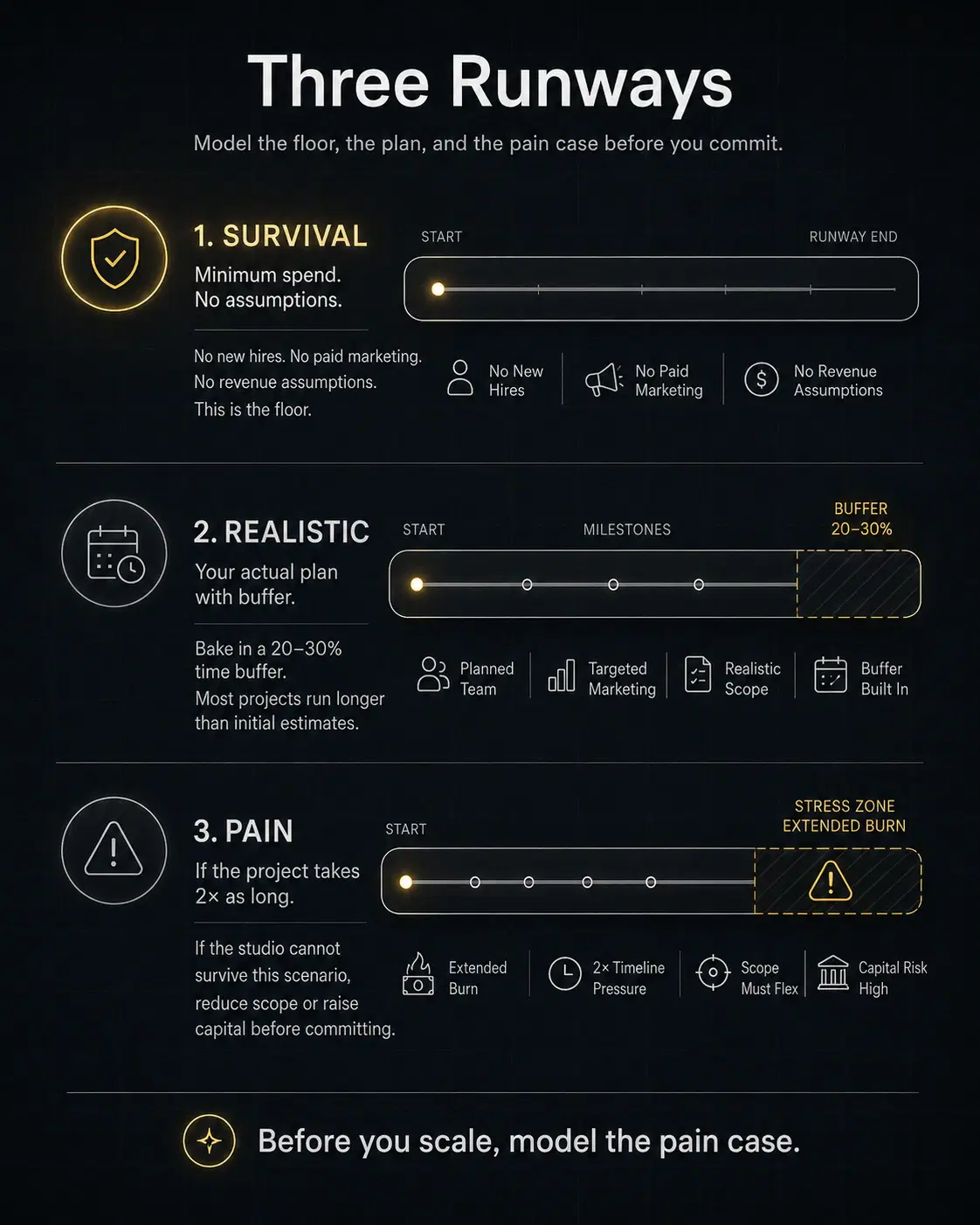
Three runways
- Survival: how long you last at minimum spend with no new hires and no paid marketing; no assumptions about revenue; this is the floor
- Realistic: your actual plan with a 20-30% time buffer baked in; most projects run longer than initial estimates
- Pain: what happens if the project takes twice as long; if the studio doesn't survive this scenario, adjust scope or raise capital before committing
Five recurring line items
Studios commonly build each scenario around five recurring line items:
- Monthly fixed costs (tools, hosting, entity maintenance)
- Variable production costs
- Founder living costs
- A marketing budget covering Coming Soon promotion and creator outreach
- A contingency, often in the 20-30% range
Founder living costs and marketing are the two most commonly omitted.
A budget that leaves them out looks healthy until month eight.
The median Steam game earns about $799 in lifetime revenue after Steam's cut (see our full breakdown on how much Steam actually takes).
Roughly half earn under $1,000.
A runway that only survives if the game hits $50K in week one is not a runway.
Pro tip
Consider building all three scenarios in a single spreadsheet. The gap between survival and pain tells you how much scope risk you are carrying.
8. The boring operations that prevent late-stage failure
Operations that feel optional at 3 people become catastrophic failures at 10.
Set them up before they feel necessary.
Operations checklist
- Version control covers all source code and assets from day one; lost work from an unversioned project is not recoverable
- Everything belongs in version control, not just the codebase; art files, audio, and design documents are equally unrecoverable without it
- Asset storage needs cloud backup with versioning, not local drives that a single hardware failure can wipe
- A task system is the single source of truth for what is being built and by whom; email threads are not a task system
- Every internal build gets a named convention and a one-paragraph note of what changed
- Contractors get least-privilege access: each receives only the files they need, nothing more
- Passwords and 2FA for all shared accounts go into a password manager from day one
- A finance tracker records actual versus planned spend every month
- Steamworks admin rights stay on a permanent founder account, not on an individual who might leave
- Open a dedicated business bank account before any studio revenue arrives; mixing personal and studio finances creates accounting complications
- Off-site backup of all sensitive documents, with a clear record of who has access to which accounts
Pro tip
The cost of skipping any of these shows up at the worst possible time: during publisher due diligence, during a handover, or the week after someone leaves.
Key takeaways
- Choose your first-project model before registering any entity; the model determines which structure you actually need.
- Get every IP ownership document signed before development starts; at formation it is a one-page fix, not a negotiation.
- Write down working agreements before development starts; norms set by default during the first crunch are harder to change than ones written at formation.
- Model three runways (survival, realistic, pain) in one spreadsheet before committing to any significant spend.
- Set up version control, a task system, and a business bank account on day one, before they feel necessary.
- Run the co-founder compatibility check before splitting equity; misalignments discovered before formation cost nothing to resolve.
Part 3: Building demand evidence from day one
Steam-native formation means the demand-building work starts when the studio does, not six weeks before launch.
9. Build a production system
Poor production hygiene is the silent killer of small studios. It rarely shows up in post-mortems; teams attribute delays to scope creep when the underlying problem is that nobody can find anything.
Four production fundamentals
Commit to an engine and don't switch. Switching mid-project costs weeks of migration work for every month of production already logged.
The right engine is the one your team knows, that supports your genre, and has a clear licensing model for your revenue band.
Everything belongs in version control, not just the codebase. Art files, audio, and design documents all rot without it.
Every build gets a date-stamped name and a one-paragraph note of what changed. Teams without build discipline lose track of when bugs were introduced and cannot reliably revert.
Know exactly what you are building at each stage. Three build types serve different purposes:
- A prototype tests whether a mechanic feels right
- A vertical slice is a polished, shippable section of the game used to demonstrate production quality to publishers
- A demo is a public-facing build designed to generate wishlists and test player retention
Treating a prototype as a publisher-ready vertical slice wastes time polishing something that should be exploring.
Treating a vertical slice as a demo means shipping internal-quality work to the public.
10. Make it Steam-native from day one
A Coming Soon page belongs in the founding plan, not the launch plan. See how to optimize your Steam store page for the full asset-by-asset breakdown once you're ready to build it out.
Every week it is live before launch is a week of wishlist growth that cannot be recovered later.
Valve recommends launching a Coming Soon page as early as possible.
The "6-12 months before launch" window is a community-derived benchmark based on observed wishlist growth patterns, not an official Valve guideline.
A live Steam page is formation-stage evidence: it shows real player behavior (wishlisting) rather than stated intent.
UTM tracking
Tag every outbound link to your Steam page with UTMs from day one, regardless of channel.
Without them, you are guessing. Source quality matters: organic wishlists convert at roughly 12% on launch day, festival-only at roughly 5% (GameDiscoverCo, 2024-25). See Steam wishlist conversion benchmarks for the full breakdown by source and genre.
A page with 10,000 wishlists of unknown provenance is worth less at launch than 5,000 predominantly organic ones.
Run a small test budget on creator outreach or paid traffic early to reveal which channels actually convert to wishlists.
Note: Getting onto Steam
Create a Steamworks partner account at partner.steamgames.com. Pay the $100 Steam Direct fee per game (recouped once the game earns $1,000). Complete banking and tax forms. Create a new app, build out the store page, and set the page status to Coming Soon. The process takes days rather than hours if banking details are not already verified.
11. Build a marketing funnel
Once you've set up your game's Steam page, you need funnels to bring players onto it.
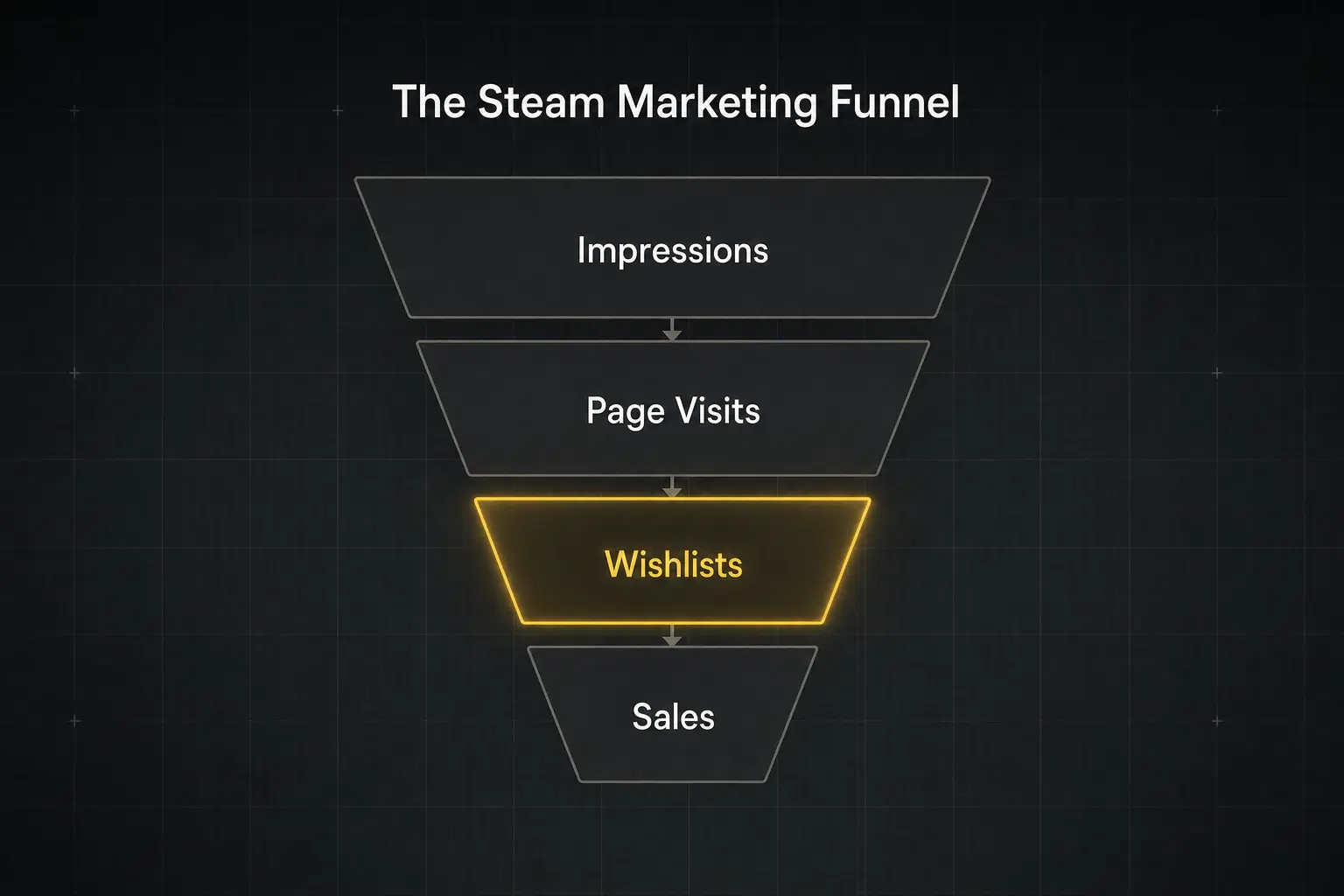
A Channel Funnel is the measurable step-by-step path a player takes inside a specific channel to get closer to buying your game.
For Steam games, most channel funnels look roughly like this, with more or fewer stages depending on the platform:
At each stage of a funnel, you can track:
- Volume: the absolute number of people who performed an action
- Conversion: the percentage of people who moved from one stage to the next
Example: reading a funnel
A video posted to TikTok gets 1,000,000 impressions. A link in the caption goes to the Steam page; 50,000 people click it, a 5% conversion rate. Of those, 10,000 wishlist the game, a 20% conversion rate.
In this example, the video with 1,000,000 impressions clearly performed well, but the goal is wishlists, not impressions. If another video got fewer impressions but drove more wishlists, it performed better overall.
12. Track where demand actually comes from
Steam UTM analytics show which campaigns drove page visits and wishlists.
They do not show the full journey of any individual player.
The same player appears as four separate data points across four separate tools.
Studios running multiple acquisition channels simultaneously are flying partially blind at the moment it matters most.
Steam's built-in launch notification reaches the entire wishlist with one generic email, regardless of engagement level.
Studios with owned, unified audience data can segment by intent before launch day; see owning your game audience for how that works in practice.
Wishlist provenance matters: the same headline count can represent very different Day 1 revenue depending on where those wishlists came from.
Example: Immutable Audience
Immutable Audience is a pre-launch player capture tool that aggregates Steam, Discord, email, and ad signals into a single owned audience.
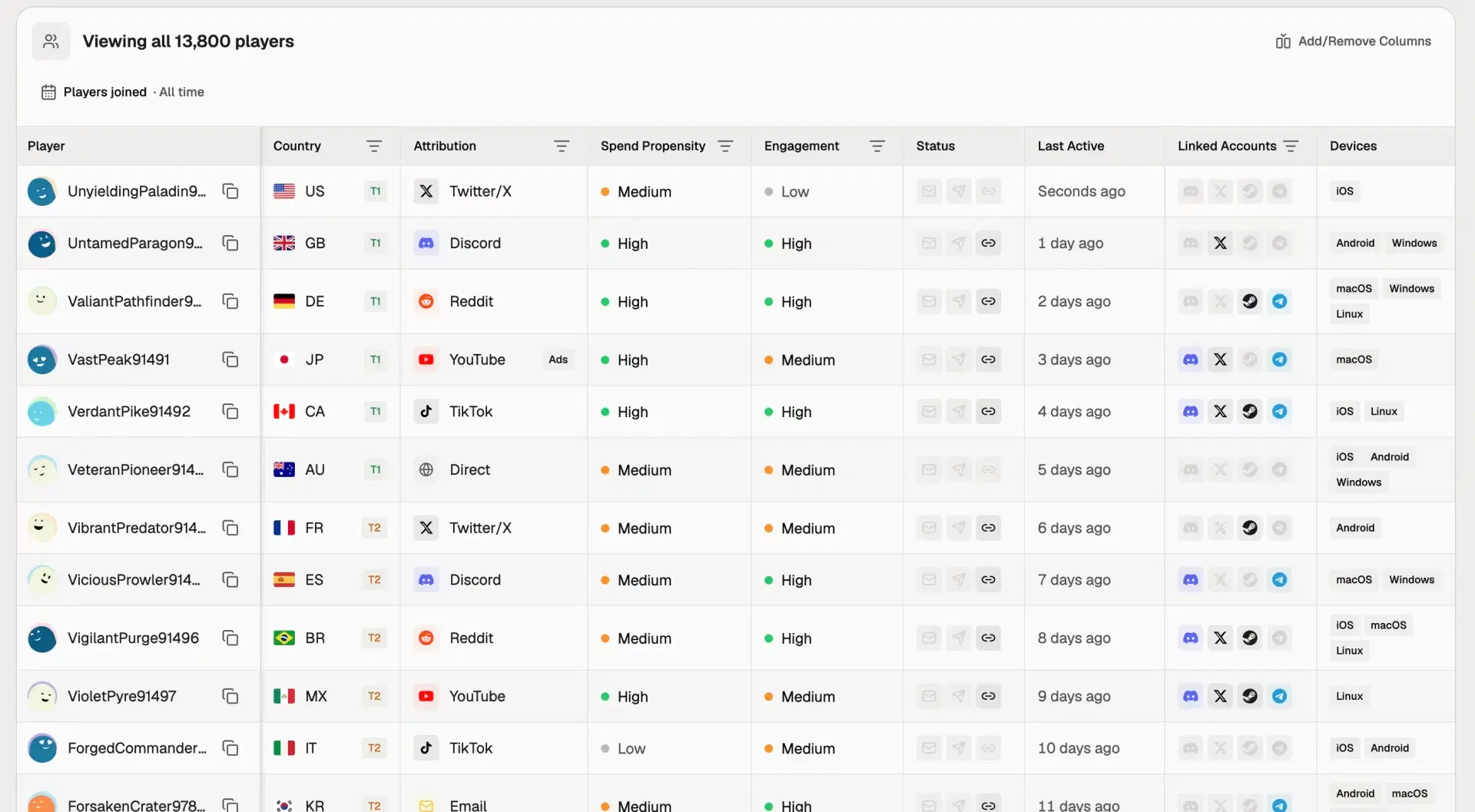
The Ubisoft / Might & Magic: Fates cohort converted at 2.8x higher on Day 1 than the standard storefront flow. The difference was pre-launch nurturing through owned channels versus a single storefront notification.
Key takeaways
- Get your Steam Coming Soon page live before you hire or raise; every week it is live compounds wishlist momentum that cannot be recovered.
- Tag every outbound link with UTMs from day one; without source data, every marketing decision is a guess.
- Track both volume and conversion at each funnel stage; a video with more impressions isn't the winner if it drives fewer wishlists.
- Know what you are building: a prototype, a vertical slice, and a demo are different things with different goals.
Part 4: Funding and staying fundable
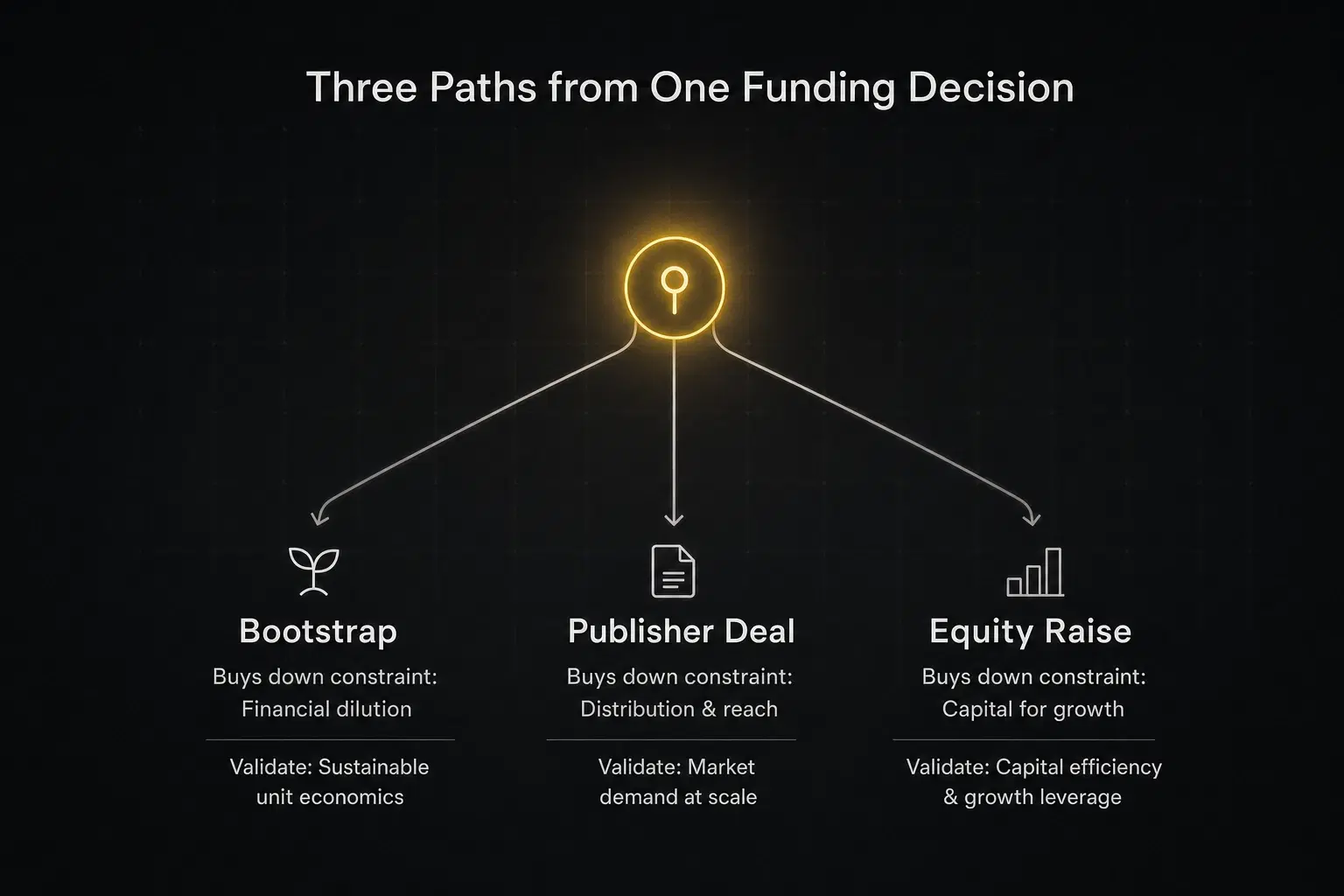
Funding solves a specific constraint. Before raising, know which constraint you are buying down.
13. Pick a funding path
Funding only helps when it buys down a real, validated constraint.
When it lets a studio avoid finding out whether players care, it becomes expensive runway on an unvalidated bet.
Six paths
| Path | What it buys | Primary cost |
|---|---|---|
| Bootstrapping | Full creative and strategic control | Time and a lower scale ceiling; only works when scope is small enough to ship before money runs out |
| Contract or consulting work | Development time through parallel income | Focus: service work competes directly with original IP development |
| Crowdfunding | Demand validation and early community alongside capital | Significant marketing effort before launch, and a failed campaign is public. Kickstarter raised $26M for successful video game projects in 2024 |
| Publisher deal | Marketing support and distribution relationships | Typical advances $100K-$2M with roughly 60% developer revenue share after recoup (GDC 2023 survey); individual terms depend on studio track record, IP ownership, and platform |
| Grants and indie funds | Capital with minimal equity cost | Application time and restrictions on commercial direction |
| Institutional investment | Scale capital and strategic connections | Equity and governance; typically requires a C-corp structure and a clear path to significant returns |
Evaluate and negotiate a publisher deal on its full term sheet, not just the revenue split, once you're at that stage.
The key question before any raise: which specific constraint does this funding buy down, and have I validated that the constraint is real?
If the answer is "we need more time to figure out if players want this," funding extends runway without reducing risk.
Warning: Legal and financial review
This is not legal or financial advice. Funding structures, equity terms, and publisher contract terms vary significantly. Consult a lawyer and accountant before signing anything.
14. Stay publisher-ready without overbuilding
Publisher readiness means your core records are clean and ready for external inspection at any time. See proving traction to publishers for the evidence publishers weigh most heavily.
Six things in the due-diligence folder
Keep these six items ready:
- Entity documents: incorporation papers, ownership structure, and cap table with no ambiguity about who owns what percentage
- IP ownership: clean IP ownership records covering every founder and every contractor who contributed significant work
- Budget and financial records: actuals against planned spend, founder living costs included, current runway model
- Demand evidence: Steam page analytics, wishlist count with UTM source breakdown, demo performance data
- Build history: dated internal build log with scope notes for each version
- Claims file: any IP, trademark, or prior-work dependencies documented in one place
Three things clear a publisher gate:
- A polished vertical slice (a deck alone is not enough)
- A budget with 20-30% contingency buffer
- Real demand evidence with UTM source attribution
Wishlists with source attribution matter. A raw number with no breakdown is hard to evaluate.
The most common preventable deal-killer is unassigned IP.
Publisher leads rarely come from cold outreach; they come from industry introductions and conference relationships.
Attending two or three industry events in the year before you are ready to pitch is worth more than a polished deck without a warm introduction.
When you have a demo ready, build your pitch for the specific partner you are approaching.
A publisher focused on narrative games evaluates writing quality and pacing; one focused on systems games evaluates depth and replayability.
Warning: Legal and financial review
This is not legal or financial advice. Due diligence requirements, IP assignment obligations, and deal structures vary by jurisdiction and by publisher. Consult a lawyer before entering any negotiations.
Key takeaways
- Fund to buy down a validated, specific constraint, not to extend time before finding out whether players care.
- Keep six due-diligence items ready at all times: entity docs, IP assignments, budget actuals, demand data, build history, claims file.
- Unassigned IP is the most common preventable deal-killer; fix it at formation, not during negotiations.
- Publisher introductions come from events and warm relationships, not cold outreach; attend two or three events in the year before you want to pitch.
- Get legal review of any publisher contract or investment term sheet before signing.
We built Immutable to help studios own their pre-launch player audience. Instead of a single storefront notification at launch, you build a segmented audience across Steam, Discord, and email while you are still in development.
The Ubisoft / Might & Magic: Fates cohort converted at 2.8x higher on Day 1 than the standard storefront flow.
Book a free demo to see what that could look like for your game.
Conclusion
Starting a studio is harder than making a game.
Every decision compounds the others: legal foundations shape funding options; funding shapes hiring; hiring shapes what you can ship.
The principle to carry forward: validate demand before scaling anything.
Before hiring, before raising, before committing to a release date, make sure real players have signalled genuine interest in a form you can measure.
Real demand evidence takes three forms:
- A Coming Soon page with UTM tracking
- A demo players complete without prompting
- A wishlist count that grows without manual pushing
That evidence is what separates a studio with options from one running on hope.
I hope this guide helps you build the right foundation before the stakes get high.
Robbie Ferguson, Co-Founder and President at Immutable
Free launch review
Start your studio with an owned audience from day one
Immutable Audience captures player data from development onward, so proving traction to publishers and investors doesn't rest on a Steam wishlist count alone.
Get my free launch review★★★★★ Trusted by Ubisoft, Netmarble, and 800+ studios