

Part 1: What Steam takes
Before modeling launch revenue, you need exact numbers for what leaves your gross before you see it. This section covers Steam's revenue share structure, why platform averages mislead indie studios, and how Direct fees and payment timing affect early cash flow.
1. The 30/25/20% tier structure
Steam's revenue share tiers: 30% on the first $10M of a game's lifetime gross, 25% on revenue between $10M and $50M, and 20% on everything above $50M.
These thresholds are tracked per game, not per publisher or studio catalog. If you ship five games that each earn $3M, every dollar across all five stays in the 30% bracket.
The tiers are also not retroactive. A game earning $12M total pays 30% on the first $10M and 25% only on the $2M above the threshold. The savings are modest until revenue scales well past the floor.
Valve describes the thresholds as revenue earned "on Steam," covering game packages, DLC, in-game sales, and Community Marketplace game fees. Revenue from other storefronts, console platforms, or key resellers should not be assumed to count toward Steam's tier thresholds.
Valve introduced this structure in 2018. The stated goal was retaining large publishers who could credibly negotiate lower terms elsewhere.
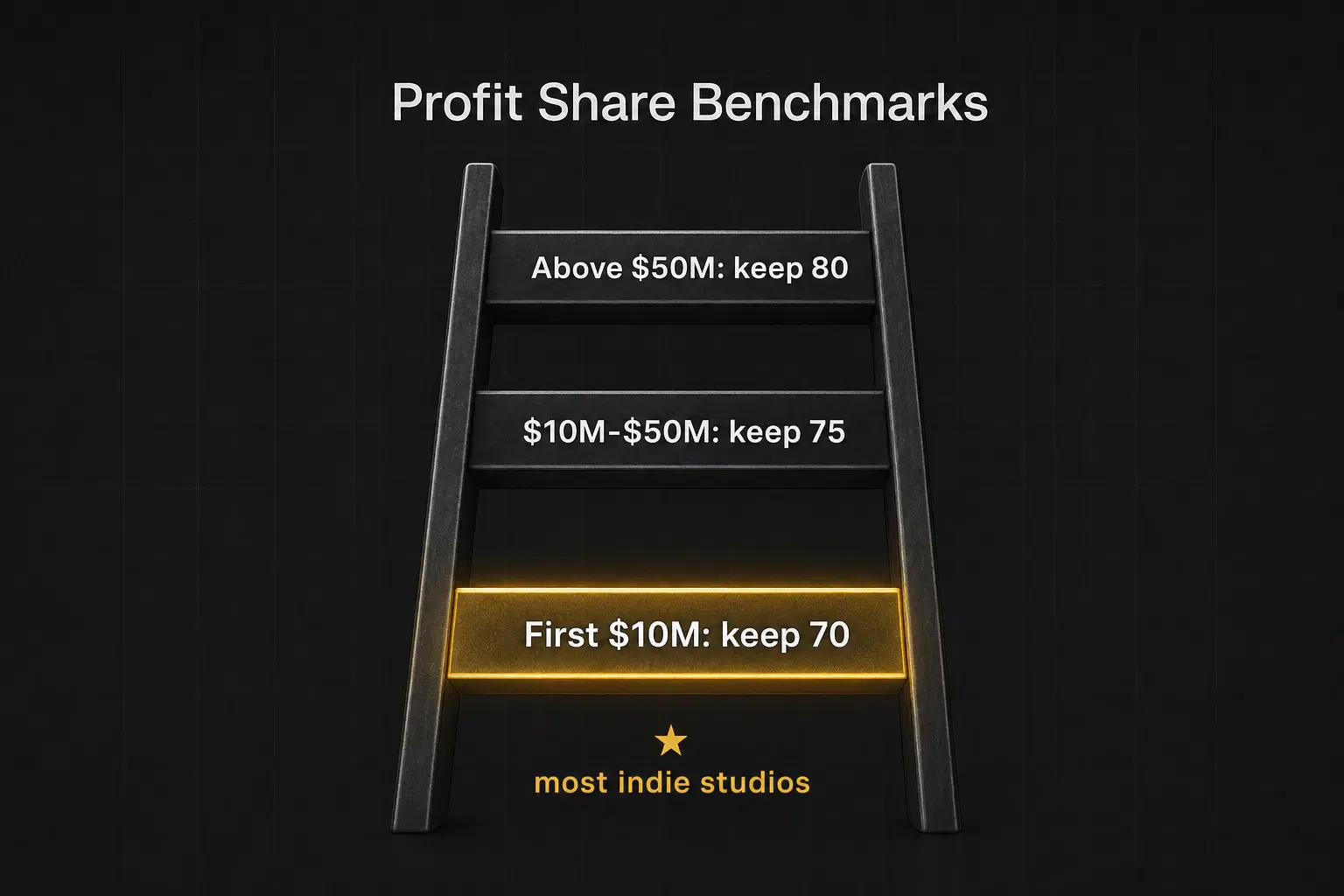
Key insight: The per-game threshold resets every title
A publisher catalog of ten games each earning $1-3M receives zero tier benefit across the catalog. Only a single title clearing $10M moves any revenue into the 25% bracket. Catalog breadth without a breakout title changes nothing.
2. Why the 24% platform average doesn't apply to your studio
A 2025 GameDiscoverCo analysis of Steam's financials found an effective platform-wide take rate of approximately 24%. That figure is accurate. It is also irrelevant to most prelaunch studios.
Steam's third-party revenue pool was roughly $14.98B in 2025. Approximately 52% of that came from games earning $50M or more lifetime, the titles paying only 20%. A small number of AAA franchises generate the majority of Steam's gross, and their lower rate pulls the platform average down substantially.
For a prelaunch studio releasing its first game, every dollar earned is at 30%. The platform average reflects a revenue pool your title almost certainly does not sit inside. VG Insights data from 2024 shows roughly 1 in 42 Steam games clears $1M lifetime. Far fewer approach $10M. If you're still validating demand before committing to a launch date, see our guide on how to start a game studio for the sequencing that comes before revenue modeling.
Warning: The "24% effective cut" is a planning error for indie studios
That figure is the revenue-weighted platform average, dominated by AAA titles paying 20%. Your effective rate is 30% unless your game clears $10M in Steam-sourced gross. Build your model around 30%.
3. Steam Direct and payment timing
Steam Direct costs $100 per app submitted, non-refundable but recoupable once your game clears $1,000 in Adjusted Gross Revenue (AGR). First-time publishers must complete identity verification, connect a bank account, and clear a 30-day waiting period before their first title can release.
Payment timing follows a fixed structure. Steam holds revenue for approximately 30 days after sale, then pays out by the 30th of the following calendar month. A game launching June 1 may not see its first payment until early August.
Payments only process when your balance clears the minimum threshold, which defaults to $100. Confirm the configurable range in your Steamworks payment settings before modeling cash flow.
Pro Tip
A studio selling modest copies at $9.99 in month one may not clear the $100 payment threshold. Factor 6-8 weeks of cash flow lag into your launch runway before your first dollar arrives.
Free launch review
Model your net revenue with someone who does it every week
Bring your price point and target regions to a 30 minute call. We'll benchmark your launch plan against our dataset from 800+ games and tell you what your real take-home looks like.
Get my free launch review★★★★★ Trusted by Ubisoft, Netmarble, and 800+ studios
Part 2: The deductions you didn't model
Steam's 30% revenue share is the first reduction. Four more compound on top of it, and most prelaunch models ignore all four.
4. VAT: removed before your 70% is calculated
Value Added Tax (VAT) is collected and remitted by Valve across a large number of countries and territories. It is deducted from the sale price before Steam calculates the 70/30 split.
The Steamworks Tax FAQ covers VAT handling in detail and links to the list of countries with US tax treaties for developers researching withholding obligations.
"The withholding rate may range from 0% to 30% withholding on U.S. source income, based on the information you provided during the tax interview... A reduced rate, including exemption, may apply if there is a tax treaty between the foreign person's country of residence and the United States."
To determine whether this applies to your game, complete the Steamworks tax interview and consult a qualified tax adviser to confirm the rate applicable to your entity.
Nothing in this article constitutes tax, legal, or financial advice. All content is provided for educational purposes only, based on publicly available information. Consult a qualified adviser before making any decisions based on this content.
5. Refunds: variable by region, product type, and launch window
Steam's refund policy grants buyers 2 hours of playtime and 14 calendar days from purchase. Refunds are processed before Steam's revenue split, so you do not pay 30% on refunded copies. The refunded gross revenue simply disappears.
A 2024 GameDiscoverCo survey of nearly 150 developers found a median refund rate of 9.5% and an average of 10.8%. Early Access titles run higher, at a median of 12.4%.
Chinese market sales show structurally elevated refund rates, with developer-reported figures ranging from 15% to 28% depending on title and genre, driven by different purchasing behaviour rather than product dissatisfaction. Lower-refund genres such as Visual Novel (~5.5%) and Puzzle (~6.2%) typically fall in the 5-7% range.
For a 10,000-unit launch at the 9.5% median, approximately 950 units are removed from gross revenue before any other deduction applies.
Key insight: Model refunds as a range, not a flat rate
A game with strong Chinese market appeal sees structurally different refund rates from a targeted Western niche game. Early Access compounds the effect further. Build three refund scenarios (optimistic 6%, base 9.5%, pessimistic 13%) into any launch model.
6. Regional pricing and the blended revenue problem
Steam recommends localised prices in each currency zone. Most developers follow those recommendations; ignoring them suppresses discovery and review velocity in high-volume markets.
Regional discounts against the USD baseline are substantial:
- Southeast Asia (IDR, PHP, THB, VND, MYR): 50-70% below USD
- CIS region (Russia, Kazakhstan, Ukraine): 40-60% below USD
- Turkey: converted to USD-based pricing in November 2023; no longer a discounted local-currency market
- Brazil: 50-70% below USD; Argentina: converted to USD-based pricing in November 2023; no longer a discounted local-currency market
- China (CNY): 40-60% below USD
- Japan / South Korea: 10-20% below USD
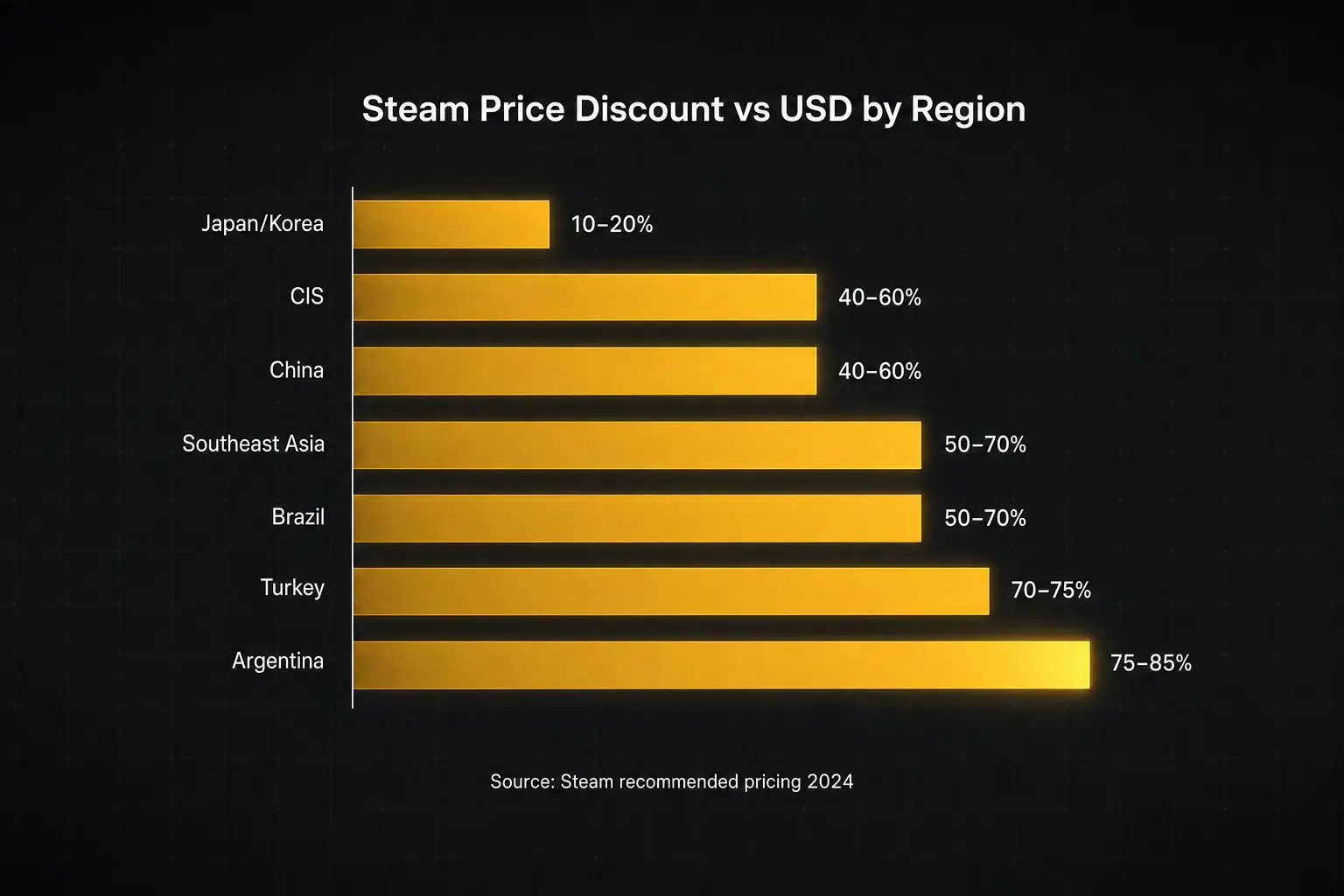
These ranges are directional and change over time as Steam updates recommended prices and currency regions. Export current Steamworks recommended prices for your specific price point rather than relying on static tables.
For a globally distributed game, the combined effect of VAT deductions and regional price variations substantially reduces per-unit revenue below USD list price. The nubosoft.de revenue calculator models this across Steam's currency regions; exact blended net depends on your price point and regional sales mix. The worked scenarios below apply these factors step by step.
Key insight: Model revenue at blended regional price, not USD list price
Build a distribution assumption covering what percentage of sales will come from US/EU versus emerging markets. Apply the regional pricing discount table to each tier. The blended price, not USD list, is the correct starting point for your net revenue model.
7. Discounts and what they do to per-unit economics
Steam runs multiple sale events per year. Participating means discounting your game; the developer absorbs 100% of that discount. Steam still takes 30% of the reduced price.
At a 33% discount, a $20 game sells for $13.40. Steam takes $4.02; you receive $9.38 before other deductions. That compares to $14 at list price: a 33% compression in per-unit net.
At 50% off, your pre-other-deductions take falls to $7. In price-sensitive regional markets during a sale, per-unit net can compress to $4-6.
Volume improvement must outpace per-unit compression to grow total net revenue. Games with meaningful sale participation typically carry a lifetime average discount of 15-25%. Bake a discounted average selling price into your long-run model, not just launch-window list price.
Part 3: Your actual net revenue
With each variable isolated, this section combines them into the adjusted net formula, shows what a publisher deal adds on top, explains the Steam Keys exception, and works through concrete scenarios from list price to developer net.
8. The adjusted net formula
Most studios build their revenue model on one line: Net = list_price × 0.70. That number is wrong by a wide margin.
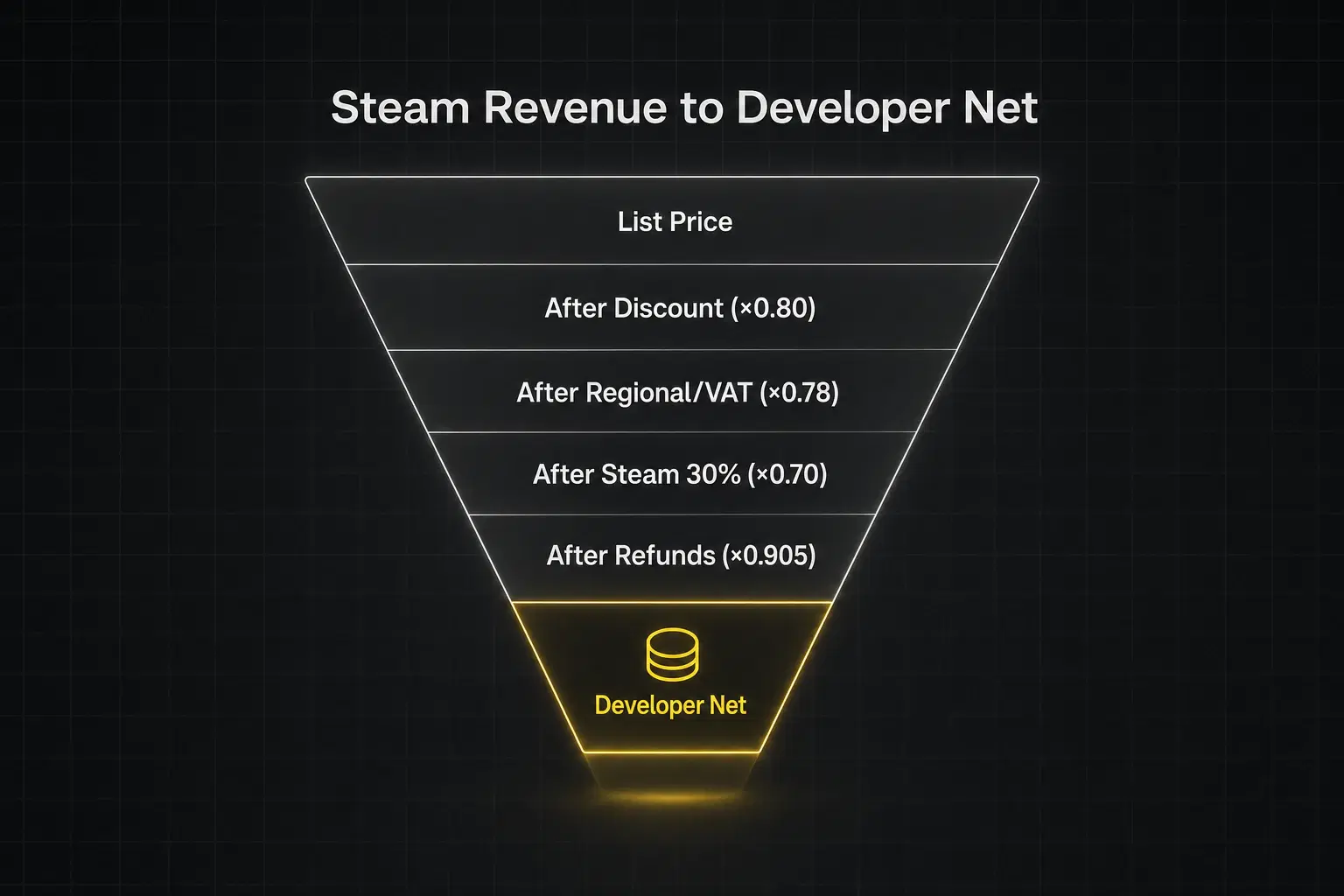
The adjusted net formula runs five variables in sequence:
Net per unit = list_price × (1 - avg_discount) × regional_blended_factor × (1 - steam_tier) × (1 - refund_rate)
Each variable compounds. A 10% reduction followed by another 10% is a 19% total loss, not 20%. Small differences stack into large gaps at scale.
The regional_blended_factor accounts for both VAT extraction and regional price reductions combined. It ranges from approximately 0.51 for fully global distribution to around 0.88 for US/EU-concentrated distribution, based on the relationship between Steam's recommended regional prices, VAT rates, and USD list price across Steam's currency regions. Treat these as illustrative inputs; build your own blended factor against current Steamworks recommended prices for your actual price point.
Key insight: A practical planning benchmark
For a typical self-published game with US/EU-weighted distribution, realistic net per unit is approximately 0.44 × list price after all deductions (regional pricing, VAT, Steam's 30%, a 20% average lifetime discount, and ~9.5% refunds). Based on the formula above applied with representative inputs; treat as an illustrative benchmark. Actual ratio will vary by regional sales mix, discount cadence, and refund rate. See the worked scenarios below for step-by-step detail.
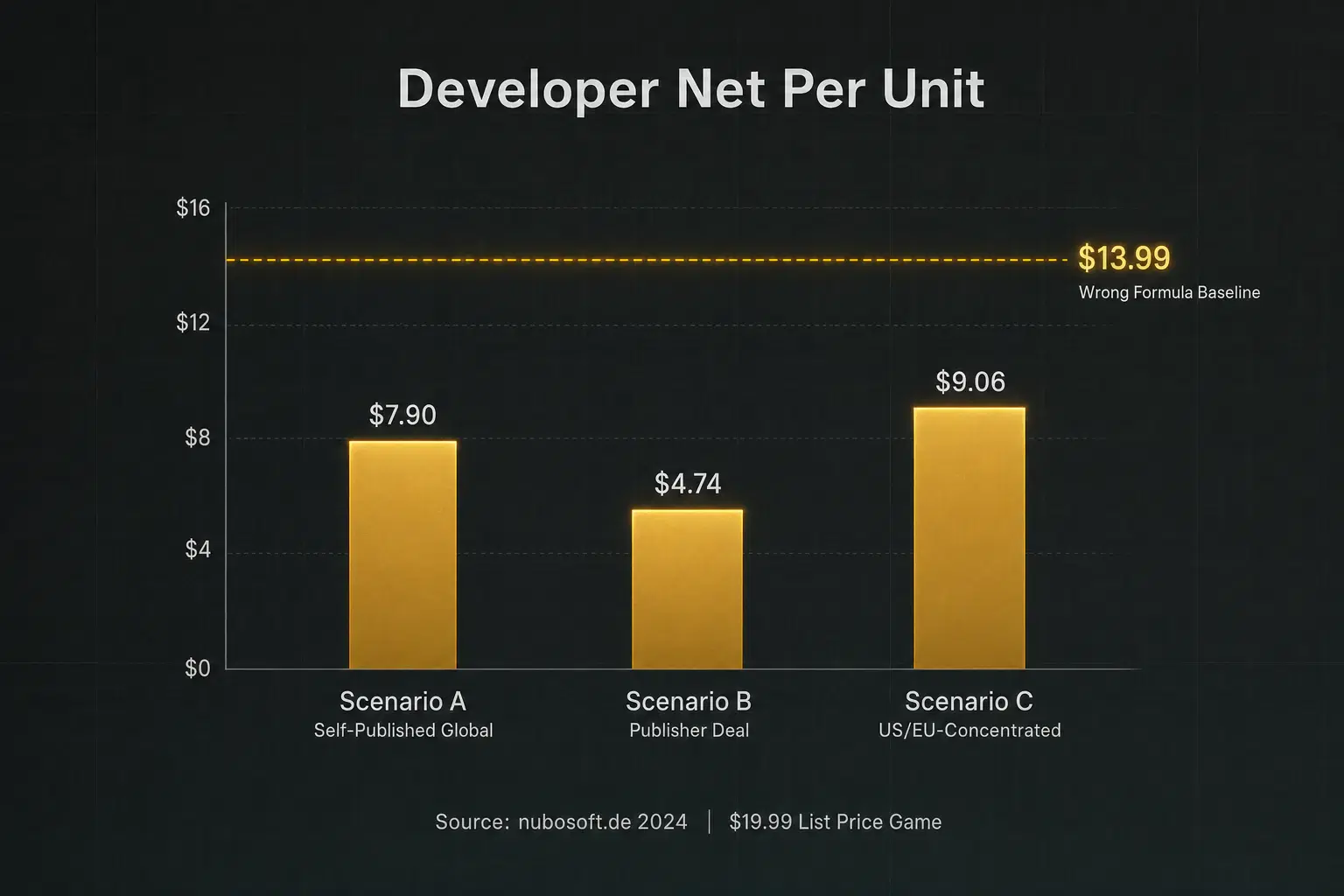
For a $19.99 game, that is roughly $8.80 net per unit (US/EU-weighted) versus $13.99 from the wrong formula. For globally distributed games with significant emerging market exposure, the ratio falls further, to approximately 0.35-0.40. The worked scenarios below apply this formula step by step.
9. Publisher deals: a second revenue share layer
A publisher deal adds a second split on top of Steam's cut. Based on a 2020 analysis of approximately 30 publishing agreements by Voyer Law (as cited by GameDiscoverCo), a common structure is 60% developer / 40% publisher, applied to Steam's 70% remittance. Deal terms vary widely; treat this as a directional benchmark, not a current market standard.
The math: the developer keeps 60% of Steam's 70% = 42% of gross before regional pricing, VAT, discounts, and refunds.
Applying the golden ratio adjustment for a $19.99 game globally distributed: the publisher deal reduces net per unit from roughly $7.90 (self-published, moderate global distribution) to approximately $4.74 after all deductions. That is a 40% reduction in per-unit economics versus self-publishing.
Advances offset development risk, and a strong publisher's marketing contribution can more than compensate through volume. Under this simplified model, a publisher would need to deliver roughly 67% more unit sales than your self-published base to offset the lower per-unit net, before considering advances, recoupment terms, marketing commitments, and risk transfer. Model the full term sheet, not just the revenue split. The per-unit floor is approximately ~$4.74 net. For the fuller tradeoff, model the full term sheet before signing.
Note on publisher deal economics
These are directional figures from a small public dataset. Publisher deals vary substantially by advance size, marketing contribution, and term structure. Studios entering publisher conversations should get independent legal review of revenue share terms before signing.
10. Steam Keys: the one exception
Steam Keys are the one mechanism where Valve takes no revenue share. Developers can generate keys through Steamworks and distribute them through any legitimate external channel: itch.io, Humble Bundle, Fanatical, or a studio's own site.
Those external platforms take their own cuts, but Valve's share is zero.
Studios with owned audiences (Discord communities, email lists, Kickstarter backers) can route loyalty or price-sensitive sales outside the 70/30 split entirely. A Kickstarter backer tier that includes a Steam key means Valve receives nothing from that transaction. Building that owned audience before launch is its own discipline; see owning your game audience for how studios do it.
Valve's policy requires keys to be used for legitimate sales channels. Valve may reject key requests that are disproportionate to actual sales volume or that appear to disadvantage Steam customers. This is not a loophole; it is a documented, intended feature of the platform.
For studios building direct community relationships before launch, keys are a meaningful tool for preserving more revenue on early supporter sales.
11. Worked model: three scenarios from list price to developer net
These scenarios use a $19.99 list price game. The "regional blended factor" accounts for VAT extraction and regional price reductions combined, based on the relationship between Steam's recommended regional prices and VAT rates across markets. All figures are illustrative; actual results depend on regional sales mix, publisher terms, and campaign performance.
Scenario A: Self-published, globally distributed
| Step | Factor | Result |
|---|---|---|
| List price | baseline | $19.99 |
| After 20% average lifetime discount | × 0.80 | $15.99 |
| After regional pricing and VAT blend (moderate global) | × 0.78 | $12.47 |
| After Steam's 30% | × 0.70 | $8.73 |
| After 9.5% refunds | × 0.905 | $7.90 |
Net per unit: ~$7.90 (vs. $13.99 from the wrong formula: 44% lower)
Scenario B: Publisher deal (60/40 split), globally distributed
| Step | Factor | Result |
|---|---|---|
| List price | baseline | $19.99 |
| After 20% average lifetime discount | × 0.80 | $15.99 |
| After regional/VAT blend (moderate global, 0.78) | × 0.78 | $12.47 |
| After Steam's 30% | × 0.70 | $8.73 |
| Developer keeps 60% (publisher takes 40%) | × 0.60 | $5.24 |
| After 9.5% refunds | × 0.905 | $4.74 |
Net per unit: ~$4.74
Scenario C: Self-published, US/EU-concentrated
For a game where 80%+ of sales are US/EU, regional price reductions are smaller and refund rates trend lower.
| Step | Factor | Result |
|---|---|---|
| List price | baseline | $19.99 |
| After 20% average lifetime discount | × 0.80 | $15.99 |
| After regional/VAT blend (US/EU-heavy, 0.88) | × 0.88 | $14.07 |
| After Steam's 30% | × 0.70 | $9.85 |
| After 8% refunds (US/EU typically lower) | × 0.92 | $9.06 |
Net per unit: ~$9.06
The tier benefit (25% instead of 30%) adds approximately $0.70-$0.90 per unit for revenue above the $10M threshold at this price point. Meaningful for a hit; irrelevant until the threshold is crossed.
Revenue model checklist
- Confirm Steam tier assumption (30% unless crossing $10M lifetime revenue on one title)
- Define regional distribution assumption (% US/EU vs. emerging markets) and select corresponding blended factor
- Set refund rate by scenario: 6% optimistic, 9.5% median, 13% pessimistic
- Estimate average lifetime discount rate (15-25% typical with standard sale participation)
- Apply regional blended factor to blended average selling price, not USD list price
- If publisher deal: confirm revenue split percentage and advance structure before modeling net per unit
- Factor Steam Direct's $100 recoupment fee and 6-8 week payment lag into cash flow model
- Confirm withholding tax treaty status if studio is outside the US (Steamworks Tax FAQ)
- Model wishlist email reach conservatively: Steam's launch notification does not guarantee delivery to all wishlisters. Treat it as a floor, not a ceiling, when projecting launch day traffic.
Conclusion
I hope this gave you a more accurate starting point than "70% of list price." The math is not complicated once you know all the variables; the problem is that most studios only model one of them.
Run the worked scenarios against your own price point and regional mix before you finalise your launch budget. The gap between the wrong formula and the right one is often the difference between a profitable launch and a confusing one. Modeling revenue accurately is only half the picture: see Steam wishlist conversion rates for how much of your wishlist actually converts on launch day.
Robbie Ferguson, Co-Founder and President at Immutable

Free launch review
Keep more of the revenue you just calculated
Steam's launch email doesn't reach every wishlister. Immutable Audience recovers that gap: EMPULSE converted owned fans to buyers at 2.2x the rate of wishlisters it couldn't reach.
Get my free launch review★★★★★ Trusted by Ubisoft, Netmarble, and 800+ studios
This content is meant to inform and educate; it's not a substitute for advice tailored to your specific circumstances. Always evaluate options in the context of your own goals, constraints, and (where relevant) professional guidance. While care has been taken in the preparation of this guide, no guarantees are made as to its accuracy, completeness, currency or that it will be error-free.