
What is email marketing for games?
Email marketing for games is collecting consented player addresses and using them to move players from discovery through wishlist, demo, launch, reviews and your next title.
It works best next to the channels you already run. Each one does a different job:
| Channel | Best at | Main limit |
|---|---|---|
| Steam wishlist | Capturing store intent | The studio never sees the player's email |
| Direct, segmented messages | You must earn consent and keep deliverability | |
| Discord | Community and conversation | Reach depends on each member's notification settings |
Why collect emails if you already have Steam wishlists?
Studios collect emails because Steam, not the studio, sends every wishlist message. Valve currently documents four triggers that notify wishlisters.
| Steam trigger | Rule (Steamworks) |
|---|---|
| Release | Early Access or full release notifies everyone wishlisting at that time |
| Early Access to full release | One further email |
| Discount | 20% or more, running over 8 hours |
| Demo | One notification, sent within two weeks of the demo going public |
A two-week cooldown, the waiting period between emails about one game, covers all of these per App ID. Only players with a verified Steam email receive them.
Four triggers leave most launch beats uncovered: playtests, trailers, Next Fest, date reveals and launch countdowns. Your own list reaches players on those days.
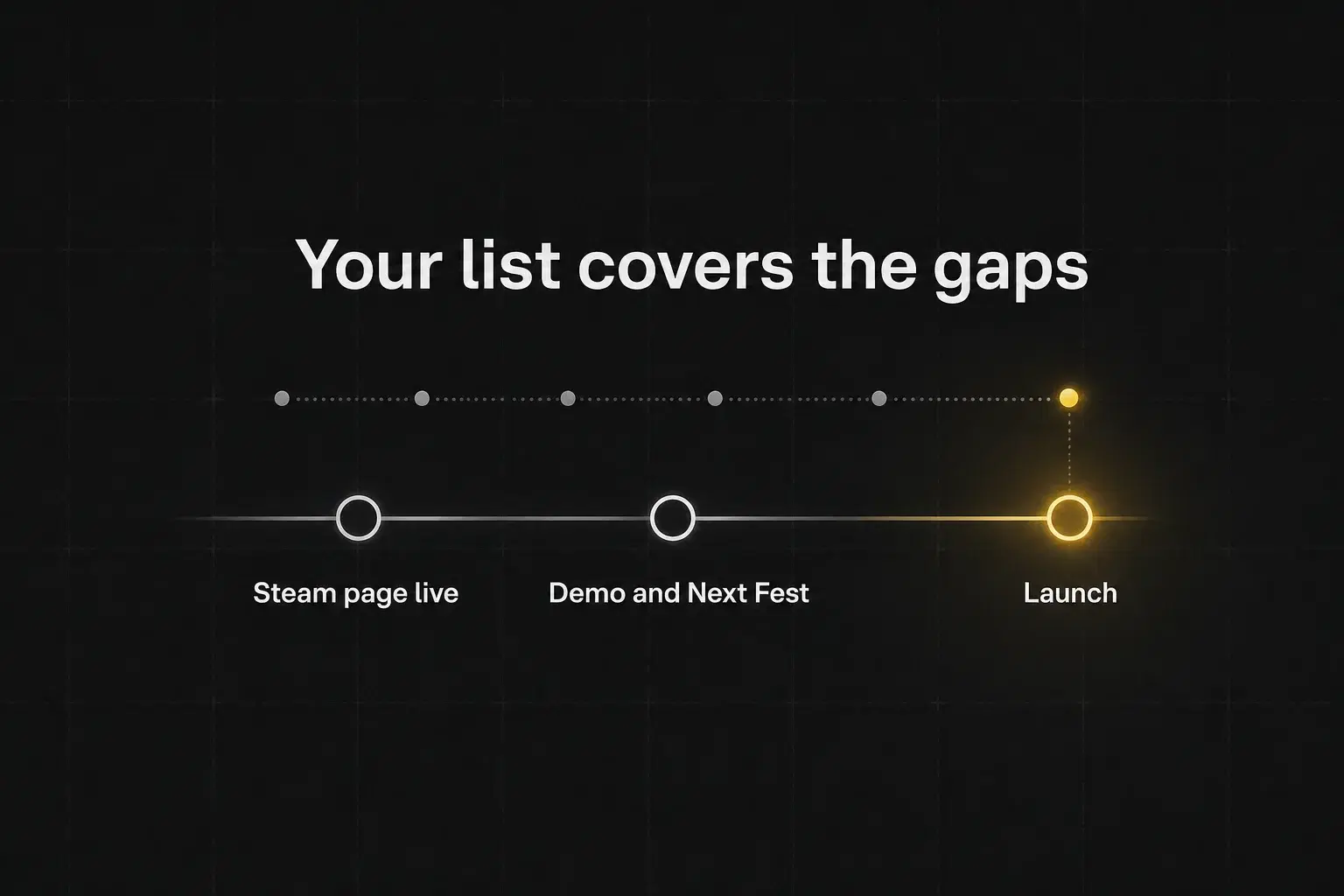
Steam wishlists also do not carry over to your next game. Studios on our calls point out that an owned list does, across sequels, DLCs, future launches and crowdfunding campaigns.
Example: Ubisoft's Might & Magic: Fates. For this free-to-play launch, Ubisoft captured emails on an Immutable landing page and ran a five-phase Engage email sequence alongside Telegram and Discord.
In the Ubisoft case study, Day 1 player conversion reached 6.64% against 2.37% for the standard storefront flow: a 2.8x lift, and 3.0x by Day 14.
The lift covers the whole owned-audience programme, not email alone, and it is one measured case, so treat it as a reference point.
Where should a game studio collect emails?
The best place to collect emails is wherever player intent already exists. A signup that promises something specific beats a generic "join our newsletter" box.
- Game landing page: capture the email, then deep-link the player to the Steam wishlist button.
- Demo follow-up: players who tried the demo have shown more intent than a passive visitor.
- Playtest registration: testers expect ongoing messages about access and feedback.
- Creator campaigns: send creator traffic to a tracked page before the store.
- Events: only where the player clearly opts in to marketing.
- Giveaways: use with care, because prize seekers inflate lists without adding buyers.
On Empulse's site, 41% of all visitors signed up with email; the flow then prompted a Steam wishlist and a Discord join.
What emails should you send before launch?
A pre-launch email plan is a short lifecycle tied to game moments, with one main call to action and one metric to watch per stage.
| Stage | When | Audience | Main call to action | Watch |
|---|---|---|---|---|
| Welcome | Right after signup | New subscribers | Wishlist or join Discord | Click rate |
| Value and dev updates | Between beats | Everyone | Watch, read, reply | Clicks, unsubscribes |
| Playtest or demo invite | When access opens | Engaged segment | Play or register | Participation |
| Next Fest | Festival week | Warm audience | Play the demo | Demo plays, wishlists |
| Date reveal | Announcement day | Full list | Wishlist | Wishlist actions |
| Launch countdown | About a week out | High-intent players | Visit the store page | Clicks |
| Launch day | Release | Everyone not yet bought | Buy or play | Purchases |
| After launch | Days 1 to 14 | Non-buyers and buyers | Buy, or leave a review | Conversion, reviews |
Plan the Steam demo and discount notifications into the same calendar. Two Steam-triggered events inside 14 days means the second one misses players still on cooldown.
How often should a game studio email players?
Email frequency for a game should follow events, not a fixed weekly slot. Send more when something real happens, and less when nothing has changed.
- Send more: demo launch, playtest opening, Next Fest, date reveal, launch week.
- Send less: quiet development stretches with nothing new to show.
- Send by engagement: a player who clicked recently and played the demo can take more launch email than one who ignored six months of sends.
Watch unsubscribes, spam complaints and clicks after every send. If sends rise but clicks do not, fix the content before the cadence.
How should game studios segment an email list?
Segmentation is splitting the list so each group gets a message that fits what they have done. It only matters when it changes the message or the ask.
| Segment type | Examples |
|---|---|
| Lifecycle | New subscriber, demo player, playtester, buyer, lapsed player |
| Behaviour | Clicked recently, joined Discord, finished a quest, referred a friend |
| Source | Creator, paid social, event, website, previous game |
| Language and region | Players you can reach in their own language |
Targeted sends are where email pulls ahead. Empulse's Private Playtest invite went to a segmented, high-intent slice of the list and earned a 43.1% click rate.
Choose translation languages from your own data. Steamworks reports wishlists by region, which tells you where your players are better than any global average.
Which email metrics matter for games?
Click rate is the email metric that matters most for games: the share of delivered emails where the player clicked. Opens are now a weak signal.
Apple's Mail Privacy Protection downloads remote content "regardless of whether you engage with the email," so an open can be recorded when nobody read it.
| Metric | What it tells you |
|---|---|
| Bounce rate | List quality; rising hard bounces mean bad addresses |
| Click rate | Deliberate interest; the main campaign signal |
| Unsubscribe rate | Relevance and frequency |
| Spam complaint rate | Deliverability risk; keep it under 0.1% at Gmail |
| Wishlists and purchases | Whether the email moved players on Steam |
Studios on our sales calls often ask how to tell whether an email click became a Steam wishlist: tag every email link with a Steam UTM link.
Steam's UTM analytics credits wishlists and purchases made within 72 hours of a tagged visit, split by source, medium and campaign.
How do you stop game emails landing in spam?
Deliverability is whether your email reaches the inbox instead of spam. Studios on our calls describe the concern as campaigns landing in "the void", where players never see them.
Gmail and Yahoo publish their sender rules. Set them up before your list is big enough to need them.
| Rule | Gmail | Yahoo |
|---|---|---|
| All senders | SPF or DKIM authentication | SPF or DKIM at a minimum |
| Bulk sender threshold | More than 5,000 messages a day to Gmail accounts | "A significant volume of mail"; Yahoo publishes no number |
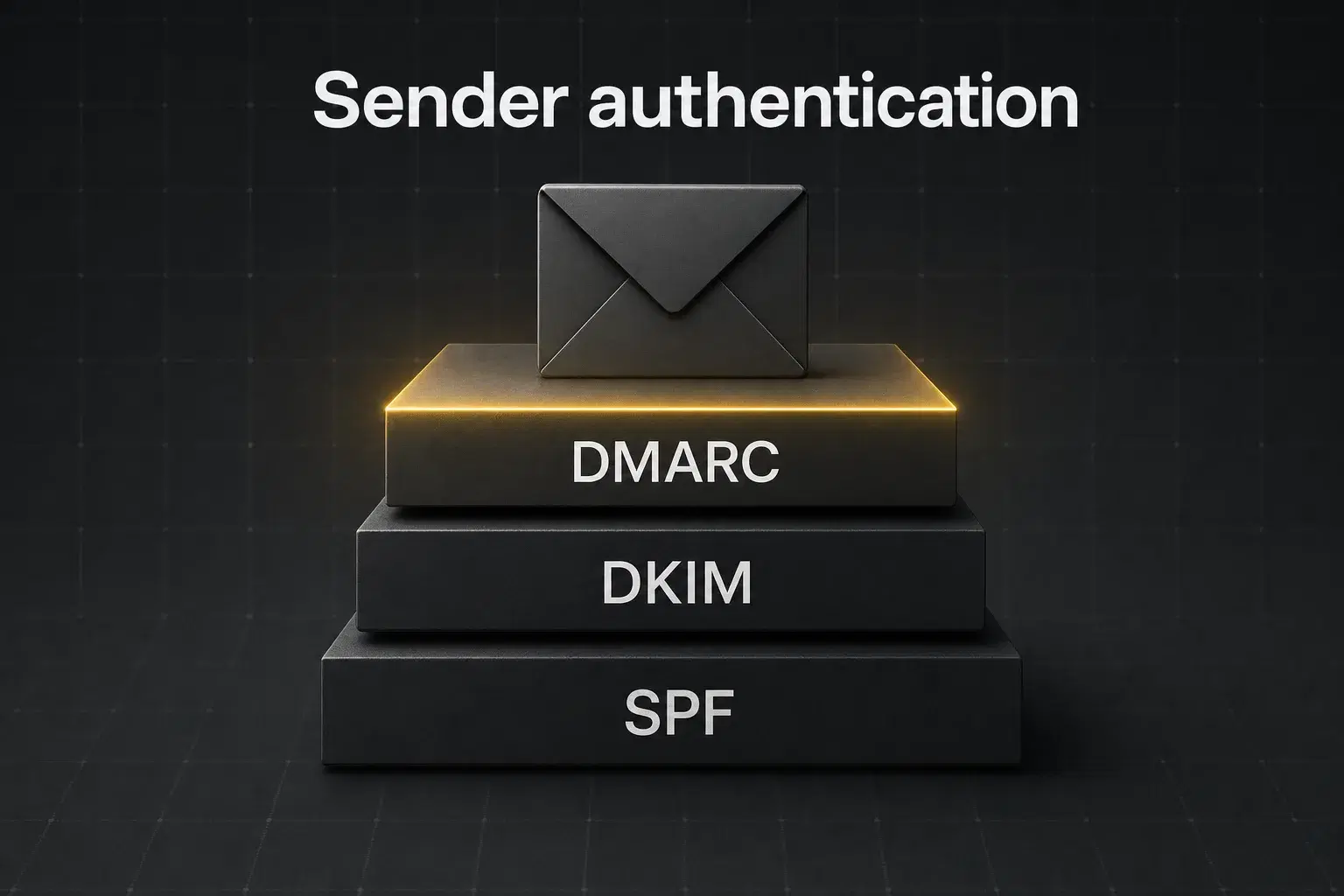
| Bulk authentication | SPF, DKIM and DMARC | SPF, DKIM and a DMARC policy that passes |
| Bulk unsubscribe | One-click unsubscribe for marketing mail | One-click unsubscribe, honoured within 2 days |
| Spam rate | Keep below 0.10%; avoid 0.30% or higher | Keep below 0.3% |
SPF, DKIM and DMARC are DNS records that prove your domain sent the email. Your email provider's setup guide will list the exact records.
- Warm up slowly: Gmail advises starting "with a low sending volume to engaged users" and increasing over time.
- Never buy lists: bought addresses bring consent, complaint and bounce problems at once.
- Separate message types: keep account and receipt emails apart from marketing sends.
What are the email consent rules for game studios?
Email consent rules are the laws on who you may email and how they opt out. This is a practical summary, not legal advice.
| Region | Law | What the regulator's guidance says |
|---|---|---|
| United States | CAN-SPAM Act | Accurate headers and subject lines, a valid postal address, a clear opt-out honoured within 10 business days |
| European Union | GDPR | Where consent is required, it must be freely given, specific, informed and clear, given by a positive act, and easy to withdraw |
| United Kingdom | PECR | Consent before unsolicited marketing to individuals, unless the soft opt-in applies; never hide your identity; provide an opt-out address |
| Australia | Spam Act 2003 | Consent, identify the sender, and honour unsubscribes within 5 working days |
The FTC puts CAN-SPAM penalties at up to $53,088 for each email in violation.
For a studio selling worldwide, our suggested cautious default:
- Ask for explicit marketing consent with an unticked box.
- Record who consented, when and where.
- Say what the player will receive.
- Put an unsubscribe link in every email.
Our reading is that joining your Discord is not consent to marketing email, so ask for email permission separately.
Common email mistakes to avoid
Five habits, each covered in more detail above:
- Only emailing at launch: a list that hears nothing for nine months and then gets "buy now" was never warmed up.
- Sending one email to everyone: a demo player and a cold subscriber need different messages.
- Judging on opens: machine opens make open rate look better than reality.
- Skipping authentication: Gmail requires SPF or DKIM from every sender, and mail that misses its rules can be blocked or marked as spam.
- Stacking Steam events: a demo notification days before launch can block the launch email.
What should an email tool for games do?
An email tool for games should connect each subscriber to the game, source and actions that matter, then trigger messages from those actions.
Beyond sending campaigns, a game email tool should:
- Capture consent and the source of every signup.
- Segment by player behaviour and lifecycle stage.
- Trigger sends from real actions, such as a demo play or a playtest signup.
- Tie email clicks to wishlists and purchases.
- Keep the audience for your next game.
Immutable Engage sends AI-personalised emails across five lifecycle stages: welcome, nurture, re-engage, pre-launch hype and convert to purchase. It is built to turn wishlisted players into Day 1 buyers.
Free launch email review
Reach the wishlisters Steam's notifications miss
Engage sends AI-personalised emails from welcome to launch day. With Ubisoft, the owned-audience cohort converted at 2.8x the standard storefront flow on Day 1.
Book an Engage demo★★★★★ Trusted by Ubisoft, Netmarble, and 700+ studios