
What is game marketing software?
Game marketing software is any tool a studio uses to find, capture, contact or measure players before and after a Steam launch.
Many studios we speak with start without a dedicated tool. One team told us they were running marketing without any platform, in shared spreadsheets, documents and a whiteboard tool.
That patchwork usually looks like this:
- Steamworks for wishlists and sales;
- Discord for community;
- an email tool for the newsletter;
- native ad and social dashboards;
- a spreadsheet joining it all together.
Studios call that spreadsheet their "de facto CRM and tracking system." The software categories below replace pieces of it.
The seven categories at a glance
The seven categories are the jobs a Steam marketing stack has to do, each defined by the data it needs and the data it hands on.
| Category | What it does | Data it needs | Data it produces | Immutable product |
|---|---|---|---|---|
| 1. Steam's own tools | Store page, wishlists, sales, link tracking | Your Steamworks account | Aggregate visits, wishlists, sales | None (Steamworks) |
| 2. Capture pages | Turn visitors into contactable players | Traffic, a tracked Steam link | Emails, Discord joins, wishlist clicks | Conversion Funnel |
| 3. Player database | One profile per player across channels | Everything captured elsewhere | Segments, player history | Audience |
| 4. Email and lifecycle messaging | Reach players at each launch moment | Consented emails, segments | Opens, clicks, return visits | Engage |
| 5. Community tools | Run Discord and social channels | Your community accounts | Joins, activity | None |
| 6. Creator marketing tools | Find, brief and track creators | Creator lists, tracked links | Creator-level traffic and signups | Amplify |
| 7. Attribution and reporting | Show which channel drove results | Tagged links, spend, Steam data | Results by channel | Attribution |
1. Steam's own tools
Steam's own tools are the Steamworks reports every developer already has: wishlists, traffic, sales and UTM link tracking.
Start here before buying anything. Steamworks reports:
- wishlist additions, deletions and purchases from wishlists, with regional breakdowns;
- traffic to your store page;
- sales and activations;
- UTM Analytics for tagged links.
UTM Analytics is Steam's link tracking. A UTM tag is a label added to a link, such as ?utm_source=homepage, so Steam can count visits from that link.
Valve's UTM Analytics documentation lists total visits, trusted visits (bots and crawlers removed) and tracked visits (logged-in users).
It counts a wishlist, purchase or activation made within 72 hours of the click.
What Steam does not give you
Steam keeps its data aggregate. The same documentation says "Steam IDs or other personal information will never be included or available."
Aggregate reporting has two limits that the other categories work around:
- You cannot see who wishlisted your game.
- You cannot message wishlisters yourself. Steam notifies them by email or mobile push at launch, on qualifying discounts and once at a demo release, as Valve's wishlist documentation sets out.
2. Capture pages
A capture page is a web page that asks a visitor for an email or Discord join as well as a Steam wishlist.
- What it does: turns a visitor from an ad, creator video or post into a player you can contact again.
- Data it needs: incoming traffic and a tracked Steam link, so the wishlist click still counts in UTM Analytics.
- Where its data goes: emails and Discord joins go to the player database. Wishlist clicks go to Steam.
Immutable's Conversion Funnel builds pages that capture email, Discord and Steam wishlist from the same visitor.
3. Player database
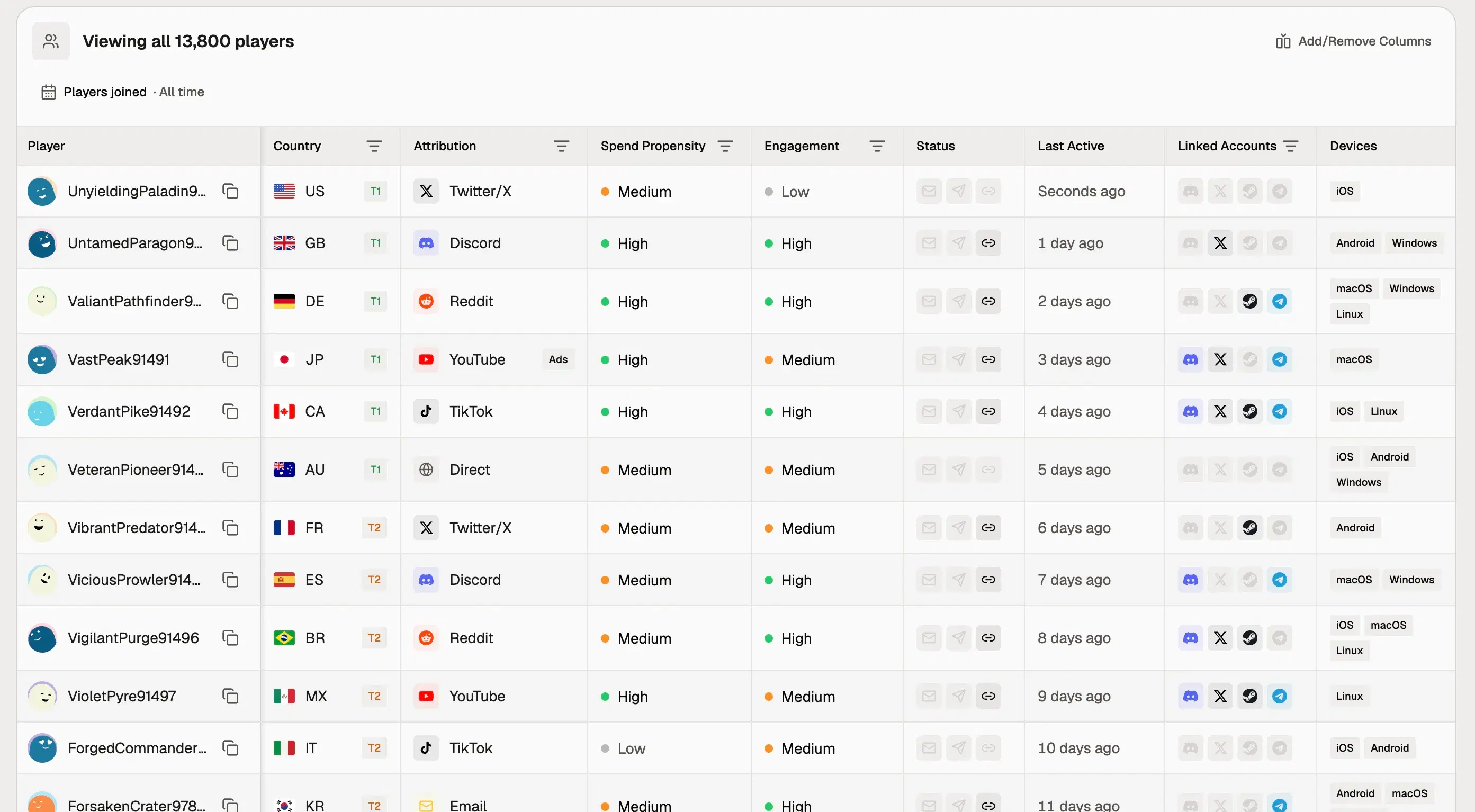
A player database is the record that holds one profile per player, joining their email, Discord, source and activity in one place.
The player database is the core of a marketing platform. Some studios call it "a game player CRM" once they see player profiles.
- What it does: answers "who is this player, where did they come from, and what have they done since?"
- Data it needs: everything the capture, email, community and creator categories collect.
- Where its data goes: segments feed email; source data feeds attribution.
Without this category, each tool holds its own partial list, and the spreadsheet becomes the database.
4. Email and lifecycle messaging
Email and lifecycle messaging software sends players the right message at each moment of a launch, from signup to launch day.
Lifecycle means the stages a player moves through: signing up, waiting for news, playing a demo, and deciding to buy.
- What it does: reaches players on your schedule, beyond Steam's own wishlist notifications.
- Data it needs: consented email addresses and segments from the player database.
- Where its data goes: opens and clicks go back to the player profile; tracked links to Steam go to attribution.
Any email tool can send these messages; a game-focused tool ties them to Steam launch moments such as a demo release or launch day.
Immutable's Engage sends automated, AI-personalized emails across five lifecycle stages.
5. Community tools
Community tools are the software a studio uses to run its Discord server and social channels.
- What it does: gives players a place to talk to the team and each other.
- Data it needs: your server and account access.
- Where its data goes: Discord joins are most useful when they land on the same player profile as the email and wishlist.
6. Creator marketing tools
Creator marketing tools help a studio find streamers and video creators, send them keys, and track what each one drives.
- What it does: replaces a creator spreadsheet with discovery, outreach and tracking in one place.
- Data it needs: creator lists and a unique tracked link or code per creator.
- Where its data goes: creator-level traffic and signups go to the player database and attribution.
Studios we speak with often cannot tell which creator drove which wishlists when several campaigns overlap.
Immutable's Amplify lets studios "find, manage, and measure creator partnerships with built-in attribution."
7. Attribution and reporting
Attribution software shows which channel or creator actually drove a wishlist or a paying player.
- What it does: connects spend and tracked links to results, channel by channel.
- Data it needs: tagged links, ad spend, Steam UTM data and captured player sources.
- Where its data goes: back to you, as a weekly answer to "what should we do more of?"
Steam's UTM Analytics is the starting point. Attribution software adds the players Steam cannot see, such as a visitor who signed up by email first.
Immutable's Attribution is cross-channel UTM-based tracking that shows which specific channel or creator drove a wishlist or a paying player.
How the categories connect
The categories connect through one shared player record, passed along in this order:
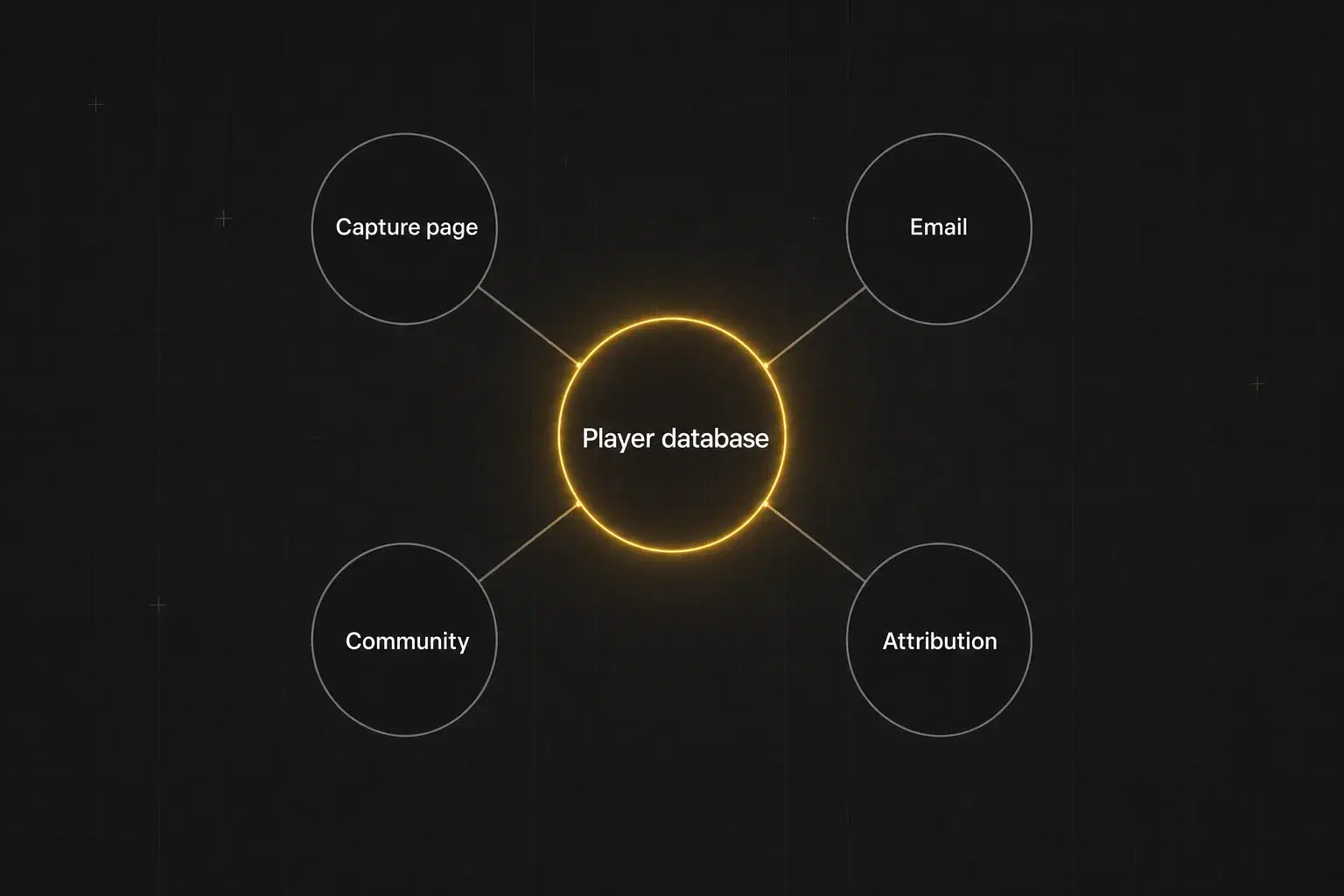
- A player sees an ad, post or creator video.
- A tracked link sends them to a capture page or the store page.
- The capture page records their email or Discord join and passes them on to Steam.
- The player database joins that signup to its source.
- Email and community reach the player again before launch.
- Attribution reports which source produced players who wishlisted and bought.
Check each new tool against that chain. A tool that cannot pass data on still does its own job, but its data reaches the rest of the stack by export.
Separate tools or one marketing platform?
Separate tools are the usual start; a single marketing platform starts paying off once joining their data by hand takes more time than the marketing itself.
| Question | Separate tools | One marketing platform |
|---|---|---|
| Setup | Quick for each tool | More setup at the start |
| Depth in one job | Often deeper | Varies by job |
| One profile per player | Joined by hand or by integration | Built in |
| Reporting | One dashboard per tool | One view |
| Moving later | Easier | Harder |
A solo developer can run on Steamworks, one email tool, Discord and a spreadsheet. Studios that later switch describe the moment as "we need to stop using spreadsheets."
Questions to ask before buying game marketing software
The best test of any marketing tool is whether it strengthens a step in the chain above.
Ask each vendor these eight questions:
- Does it understand Steam wishlists, demos and launch timing?
- What player data does it capture, and with what consent?
- Can it pass that data to the other categories you use?
- Does it keep Steam's tracked link intact when it sends players on?
- What does it measure directly, and what does it estimate?
- Can you build segments from source and behaviour?
- Can you export your players and campaign data?
- How much engineering time does setup need?
Where Immutable Audience fits
Immutable Audience is "the AI-native growth platform game studios use from first click to launch day," covering categories 2, 3, 4, 6 and 7 in one place.
- Conversion Funnel captures email, Discord and Steam wishlist from the same visitor.
- Audience turns "anonymous traffic into identified players."
- Engage sends lifecycle emails that turn wishlisters into Day 1 buyers.
- Amplify finds, manages and measures creator partnerships.
- Attribution shows which channel or creator drove a wishlist or paying player.
Ubisoft used Conversion Funnel and Engage for Might & Magic: Fates, a free-to-play card game on mobile and PC, reaching players by email, Telegram and Discord.
Day 1 player conversion reached 6.64% versus 2.37% on the standard storefront flow, a 2.8x lift, and was 3.0x by Day 14.
The case study credits that lift to Immutable Audience working together with Ubisoft's own publishing efforts (read the Ubisoft case study).
If you only need one category covered, a single tool may suit you better. See how Audience works.